

How to Pick the Right Plywood for Home Interiors

Introduction
What’s the point of selecting premium laminates if you are not investing in quality plywood?
The quality of your plywood determines how long your interiors will last.
You might spend hours selecting colours and finishes, but if the base material is weak, even the best design won’t survive daily wear and tear.
Plywood is the backbone of most modern interiors, from modular kitchens to wardrobes. It’s important to understand its types, properties, and ideal usage, which can help you avoid costly mistakes and build furniture that lasts for years.
In this blog, we’ve explained how to pick the right plywood for your home interiors and common mistakes you should avoid.
Table of Contents:
What is Plywood and Its Types
Plywood is an engineered wood product made by bonding multiple thin layers of wood veneers (called plies) together. These layers are arranged in alternating grain directions and bonded with strong adhesives, typically phenolic or urea-formaldehyde resins, under high pressure and heat.
This cross-grain structure gives plywood its strength, stability, and resistance to warping.
Plus, they are highly customizable. That’s why plywood is mostly used in modular and semi-modular kitchen interior works.
Common Types of Plywood:
MR (Moisture-Resistant) Plywood - Suitable for indoor furniture such as wardrobes and beds, where moisture exposure is minimal.
BWR (Boiling Water Resistant) Plywood - Offers better resistance to moisture compared to MR. Used in areas like kitchens where occasional water exposure occurs.
BWP (Boiling Water Proof) Plywood - The highest grade of plywood. It is chemically treated and bonded with superior adhesives, making it highly resistant to water, humidity, and extreme conditions.
Standard plywood boards are manufactured with uniform thickness and minimal core gaps, ensuring durability. High-quality boards also offer reinforced strength and improved screw-holding capacity (SSR), making them reliable for long-term use.
Why BWP Plywood Stands Out

BWP plywood is considered the highest grade material in plywood. It is chemically treated to resist water damage and bonded with high-quality phenolic formaldehyde resin, making it extremely durable.
But what does BWP exactly mean?
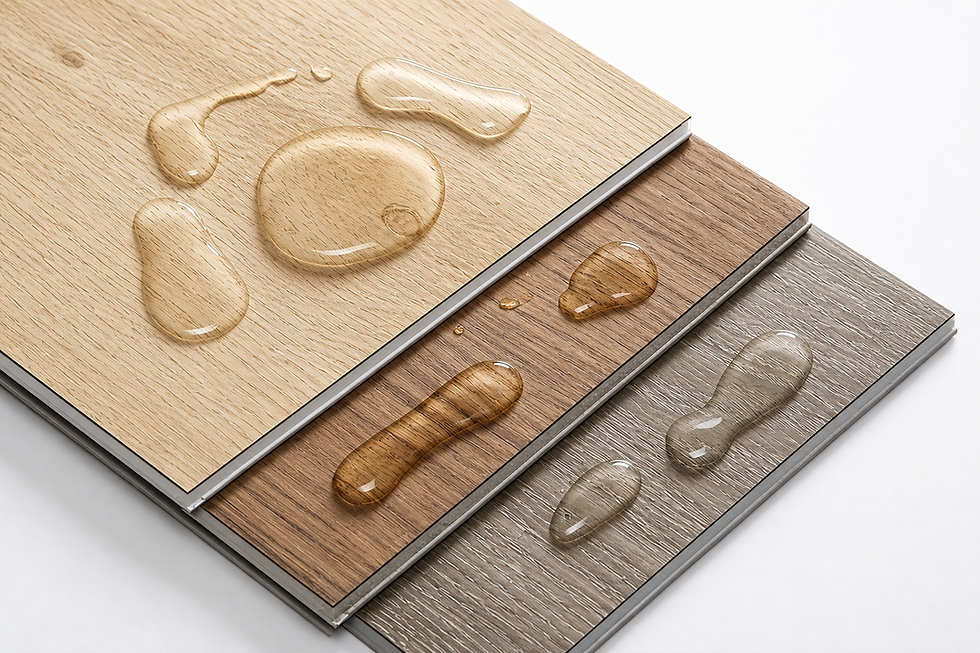
All the BWP-certified plywood will undergo the Boiling Water Plywood test. In it, the plywood is subjected to boiling water for 72 hours without delamination. It proves that the plywood has:
Excellent water resistance
High durability in humid conditions
Strong bonding and minimal core gaps
Long lifespan even in challenging environments
However, BWP plywood is also heavier.
If you use BWP for shutters (cabinet doors), the extra weight can strain the hinges over time. So, always use high-quality branded hinges.
Key Factors to Consider Before Choosing BWP
1. Area of Application
Different spaces require different types of plywood. For example, a bedroom wardrobe doesn’t need the same level of water resistance as a kitchen cabinet.
2. Moisture Exposure
If the plywood will be exposed to water, humidity, or steam, you need a higher grade like BWR or BWP.
3. Load-Bearing Capacity:
For shelves, cabinets, and storage units, ensure the plywood has good strength and better screw-holding capacity.
4. Thickness and Uniformity:
Always go for quad-pressed plywood. Because it offers consistent thickness and minimal internal gaps. Poor-quality plywood often has uneven cores that reduce durability.
5. Anti-termite and Anti-Borer:
The main concern about any plywood is termites. So, choose BWP Plywoods, which are chemically treated to resist termite attack.
6. Weight Consideration:
Heavier plywood often indicates higher density and durability. But it may not always be ideal for all applications.
Here’s a common mistake people make In Home Interior
The mistake we often see homeowners make is that they only use waterproof plywood for the kitchen base units.
But our designer says it isn’t the best approach.
Because the base units actually have less exposure to water compared to wall units and lofts, which are constantly exposed to steam and moisture.
So when the interior designer company says they’re using waterproof plywood for your kitchen, make sure it applies to the entire setup, wall units, lofts, tall units, and utility storage, not just the base cabinets.
In simple terms, BWP is better than BWR because it is more chemically treated to resist water in the long run.
How to Identify Genuine BWP Plywood
Not all plywood sold as “BWP” is truly waterproof. Here’s how to check authenticity:
1. Certification Marks - Look for ISI certification (IS:710 for BWP grade). This ensures the plywood meets industry standards.
2. Boiling Water Test - Genuine BWP plywood can withstand boiling water exposure without delamination.
3. Check the Core - Good quality plywood will have minimal gaps and a uniform core.
4. Brand Reputation - Stick to trusted manufacturers to avoid counterfeit or low-grade materials.
5. Weight and Density - BWP plywood is generally heavier due to its high density and strong bonding.
Expert Tips From Our Designers
Always select your plywood type according to your environment, not just the furniture.
For kitchens, it’s always best to use BWP Plywood all over the kitchen. Because the kitchen is exposed to steam, not just water spills.
Invest more in premium plywood than in laminates and finishes.
Ask your interior designers detailed questions about the materials being used.
If you use BWP in heavy applications, install high-quality branded hinges.
Conclusion
BWP plywood clearly stands out when it comes to water resistance and longevity, especially in kitchens, bathrooms, and utility areas. But like any material, it should be used thoughtfully, not blindly.
Because interior design is a long-term investment. The durability and quality are as important as the final look.
The first step is to verify its quality and avoid shortcuts. If you do that, your interiors won’t just look good, but they’ll last.
Frequently Asked Questions:
1. Is branded plywood worth the extra cost?
Yes, Branded plywood uses advanced techniques like quad compress technology and VPC. So, it offers better quality control, durability, and warranties.
2. What type of plywood is best for home interiors?
It depends on the place and usage. But we recommend going for BWP plywood. It offers higher water resistance and durability.
3. How can I protect plywood from termites?
Always choose termite-resistant and chemically treated plywood. When installing, don’t allow the backsheet to touch the wall.
4. How long does good-quality plywood last?
With proper maintenance, high-quality plywood can last 15–25 years or more.
5. How do I identify if plywood has core gaps?
Check the edges of the board. Good plywood will have tight, uniform layers with no visible holes or gaps.


prefect